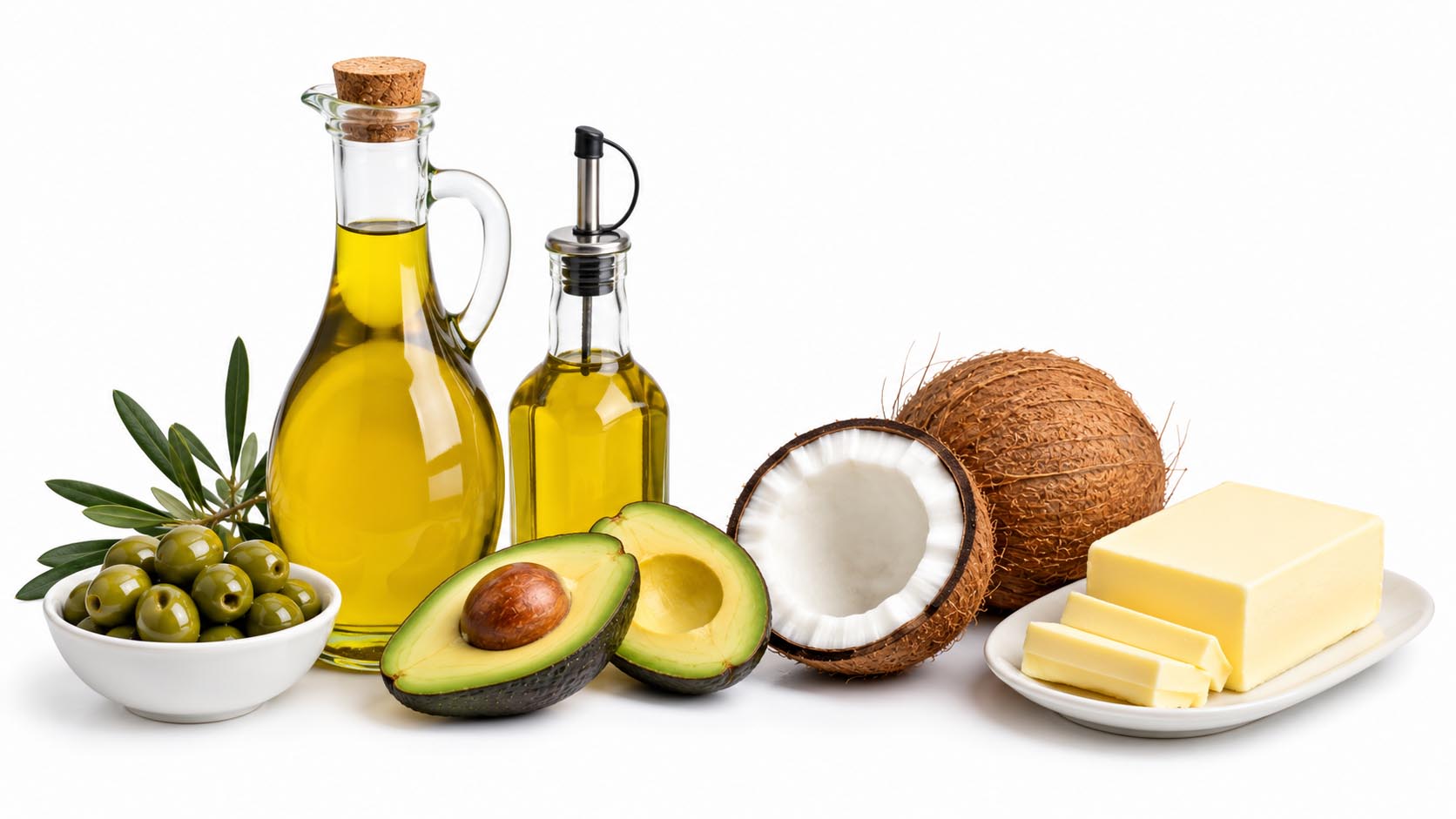
Oils and Fats: Cooking Reference and Fatty Acid Profiles
Oils and fats are the most calorie-dense foods in any kitchen, providing about 9 kcal per gram (more than double the 4 kcal per gram delivered by protein or carbohydrate). Their nutritional interest is not in the macros but in the fatty-acid profile. Different oils and fats carry very different ratios of saturated, mono-unsaturated and poly-unsaturated fats, and within those families different specific fatty acids do different things in the body.
The mono-unsaturated heavyweights are olive oil, rapeseed oil and avocado oil. All are dominated by oleic acid, which has been linked in long-term observational studies to better cardiovascular outcomes. Olive oil in particular is the canonical Mediterranean-diet oil, and extra-virgin grades retain polyphenols that refined olive oil loses during processing. Rapeseed (called canola in the US, but UK packs almost always say rapeseed) is the British-grown alternative, with a similar mono-unsaturated profile and a higher smoke point.
Sunflower, safflower, soybean and corn oils are dominated by poly-unsaturates, primarily linoleic acid (an omega 6 fatty acid). They tolerate moderately high cooking temperatures and tend to be the cheapest neutral-flavoured oils on the shelf. Cold-pressed flaxseed and walnut oils carry alpha-linolenic acid (ALA, an omega 3) but are not heat-stable and should be used in dressings rather than for cooking.
Butter, lard, beef dripping, duck fat and goose fat are the traditional UK animal fats. They are higher in saturated fat than vegetable oils but contribute distinctive flavours and high smoke points; goose fat is unusually high in mono-unsaturates for an animal fat. Coconut oil sits with the saturated fats nutritionally despite being plant-derived. Ghee (clarified butter) has the milk solids removed and works well at higher temperatures than ordinary butter.
Smoke point matters in cooking. Refined oils (rapeseed, sunflower, refined olive, peanut, vegetable) tolerate frying temperatures of 200 °C and above. Extra-virgin olive oil, butter and unrefined nut oils are best on cold or medium-low-heat dishes; pushed too hot, they develop bitter flavours and lose their interesting compounds. UK NHS guidance suggests replacing some saturated fats with unsaturated forms where the cooking allows, while keeping total fat sensible. The entries below cover individual oils and animal fats, with per 100 g energy and saturated-fat content on each page.
Bearded Seal Oil (Oogruk, Alaska Native)Bearded seal oil (oogruk) provides 899 kcal and 100 g of fat per 100 g — a traditional Alaska Native subsistence food rich in omega-3 fatty acids. Full nutritional guide.
Whale OilWhale oil provides 900 kcal and 100 g of fat per 100 g — a marine fat with a complex history. Nutritional reference data and cultural and historical context.
Spotted Seal Oil (Alaska Native)Spotted seal oil provides 894 kcal and 100 g of fat per 100 g — a traditional Alaska Native subsistence fat with high omega-3 content. Full nutritional guide.
Flaxseed Oil (Linseed Oil)Flaxseed oil provides 884 kcal and the highest ALA omega-3 content of any plant oil. Full nutrition facts, omega-3 evidence, and guide to using flaxseed oil.
Corn Oil (Maize Oil)Corn oil provides 884 kcal and 100 g of fat per 100 g — a widely used cooking oil rich in omega-6 linoleic acid. Full nutrition facts and cooking guide.
Walrus Oil (Alaska Native)Walrus oil provides 900 kcal and 100 g of fat per 100 g — a traditional Alaska Native subsistence food. Full nutritional guide and cultural context.
Beluga Whale Oil (Alaska Native)Beluga whale oil provides 900 kcal and 100 g of fat per 100 g — a significant traditional food in Alaska Native coastal communities. Full nutritional guide.
Corn and Canola Oil BlendCorn and canola oil blend provides 884 kcal and 100 g of fat per 100 g — a balanced cooking oil blend. Full nutrition facts and guide.
Vegetable Shortening (Household)Household shortening provides 884 kcal and 100 g of fat per 100 g — solid vegetable fat for baking and frying. Full nutrition facts, history, and baking guide.
Soybean OilSoybean oil provides 884 kcal and 100 g of fat per 100 g — the most widely produced vegetable oil in the world. Full nutrition facts and cooking guide.
Rice Bran OilRice bran oil provides 884 kcal and 100 g of fat per 100 g — widely used in Asian frying with a high smoke point and unique phytosterols. Full nutrition facts.
Wheat Germ OilWheat germ oil provides 884 kcal and 100 g of fat per 100 g — the richest food source of vitamin E available. Full nutrition facts, health benefits, and guide.
Palm OilPalm oil provides 884 kcal and 49.3 g of saturated fat per 100 g. An honest guide covering nutrition, health context, and the major environmental concerns.
Sesame OilSesame oil provides 884 kcal and 100 g of fat per 100 g — a foundational flavouring oil of East and South Asian cuisine. Full nutrition facts, history, and cooking guide.
Sunflower OilSunflower oil provides 884 kcal and 100 g of fat per 100 g — widely used for frying and baking. Full nutrition facts, fatty acid comparison, and cooking guide.
Regular MargarineRegular margarine provides 719 kcal and 80.5 g of fat per 100 g. Full nutrition facts and a guide to regular margarine and its uses.
Cottonseed OilCottonseed oil provides 884 kcal and 100 g of fat per 100 g — historically significant as one of the first commercially refined vegetable oils. Full guide.
Safflower OilSafflower oil provides 884 kcal and 100 g of fat per 100 g — one of the lowest saturated fat oils available. Full nutrition facts and culinary guide.
Grapeseed OilGrapeseed oil provides 884 kcal and 100 g of fat per 100 g — a light, high smoke point oil rich in vitamin E and linoleic acid. Full nutrition facts and culinary guide.
Walnut OilWalnut oil provides 884 kcal and 100 g of fat per 100 g — rich in omega-3 ALA and ideal for salad dressings. Full nutrition facts, history, and culinary guide.
Almond OilAlmond oil provides 884 kcal and 100 g of fat per 100 g — rich in oleic acid with a delicate, nutty flavour. Full nutrition facts and culinary guide.
Apricot Kernel OilApricot kernel oil provides 884 kcal and 100 g of fat per 100 g — a light, mild oil with high oleic acid content. Full nutrition facts and guide.
Vegetable Oil (Blend)Vegetable oil provides 884 kcal and 100 g of fat per 100 g — an everyday cooking oil blend. Full nutrition facts and a guide to choosing cooking oils.
Industrial Oil (Food Processing)Industrial food processing oil provides 900 kcal and 100 g of fat per 100 g — formulated for commercial food manufacturing. Nutrition facts and information.
Ghee (Clarified Butter)Ghee (clarified butter) provides 900 kcal and 100 g of fat per 100 g — pure butterfat with a high smoke point. Full nutrition facts, history, and a complete cooking guide.
Beef Tallow (Dripping)Beef tallow provides 902 kcal and 100 g of fat per 100 g — rendered beef fat with a high smoke point. Full nutrition facts, history, and a complete cooking guide.
LardLard provides 902 kcal and 100 g of fat per 100 g — rendered pork fat with a long culinary history. Full nutrition facts, history, fat composition, and cooking guide.
Peanut Oil (Groundnut Oil)Peanut oil (groundnut oil) provides 884 kcal and 100 g of fat per 100 g — excellent for high-heat frying. Full nutrition facts, history, and cooking guide.
Coconut OilCoconut oil provides 892 kcal and 82.5 g of saturated fat per 100 g. An honest review of the health claims, science, and culinary uses of coconut oil.
Olive OilOlive oil provides 884 kcal and 100 g of fat per 100 g — the cornerstone of Mediterranean cooking and one of the most health-evidenced dietary fats. Full guide.
Low-Fat Spread (Half-Fat)Low-fat spread provides 349 kcal and 38 g of fat per 100 g — approximately half the fat of butter or margarine. Full nutrition facts and a guide to low-fat spreads.
Poppy Seed OilPoppy seed oil provides 884 kcal and 100 g of fat per 100 g — a delicate, high-PUFA drying oil with culinary and artistic uses. Full nutrition facts and guide.
Tomato Seed OilTomato seed oil provides 884 kcal and 100 g of fat per 100 g — a by-product oil with a pleasant flavour and notable lycopene content. Full nutrition facts.
Tea Seed Oil (Camellia Oil)Tea seed oil (camellia oil) provides 884 kcal and 100 g of fat per 100 g — the "Asian olive oil," rich in oleic acid with a high smoke point. Full guide.
Soya LecithinSoya lecithin provides 763 kcal and 100 g of fat per 100 g — the phospholipid emulsifier from soybeans used in food manufacturing. Full nutrition facts and information.
Hazelnut OilHazelnut oil provides 884 kcal and 100 g of fat per 100 g — a rich, deeply flavoured finishing oil for salads and pastry. Full nutrition facts and culinary guide.
Babassu OilBabassu oil provides 884 kcal and 81.2 g of saturated fat per 100 g — a highly saturated tropical palm oil from Brazil. Full nutrition facts and information.
Shea Oil (Shea Butter)Shea oil provides 884 kcal and 46.6 g of saturated fat per 100 g — a West African fat used in cooking and cosmetics. Full nutrition facts and guide.
Cooking Oil SprayCooking oil spray provides 792 kcal and 78.7 g of fat per 100 g — a low-calorie way to grease pans and cook with minimal added fat. Full nutrition facts and guide.
Vegetable Oil SpreadVegetable oil spread provides 606 kcal and 68.3 g of fat per 100 g — a lower-fat plant-based spread. Full nutrition facts and guide to vegetable spreads.
MargarineMargarine provides 730 kcal and 80.3 g of fat per 100 g — a plant-based butter alternative. Full nutrition facts, history of trans fats, and a complete guide.
Cooking and Salad Oil (Blend)Cooking and salad oil blend provides 884 kcal and 100 g of fat per 100 g. Nutrition facts and a guide to multipurpose oil blends.
Confectionery ShorteningConfectionery shortening provides 884 kcal and 100 g of fat with 65.5 g saturated fat per 100 g — highly saturated for chocolate and confectionery work. Full guide.
Rapeseed Oil (Canola)Rapeseed oil (canola) provides 884 kcal and 100 g of fat per 100 g — low in saturated fat and high in omega-3. Full nutrition facts, history, and cooking guide.
Mustard OilMustard oil provides 884 kcal and 100 g of fat per 100 g — a pungent, strongly flavoured cooking oil fundamental to Bengali, Punjabi, and Nepali cooking. Full guide.
Light Butter (Half-Fat)Light butter provides 499 kcal and 55.1 g of fat per 100 g — approximately half the fat of standard butter. Full nutrition facts and a guide to light butter uses.
Industrial MargarineIndustrial margarine provides 714 kcal and 80 g of fat per 100 g — formulated for commercial food production. Full nutrition facts and information.
Salted ButterSalted butter provides 717 kcal and 81.1 g of fat per 100 g. Full nutrition facts, history, fat composition, health context, and a complete guide to cooking with butter.
Whipped ButterWhipped butter provides 731 kcal and 78.3 g of fat per 100 g — aerated for easy spreading. Full nutrition facts and guide to whipped butter.
Unsalted ButterUnsalted butter provides 717 kcal and 81.1 g of fat per 100 g — the baker's choice. Full nutrition facts, fat composition, and a complete cooking and baking guide.
Cupuaçu OilCupuaçu oil provides 884 kcal and 53.2 g of saturated fat per 100 g — a tropical Amazonian butter with cosmetic and culinary uses. Full nutrition facts.
Chicken Fat (Schmaltz)Chicken fat (schmaltz) provides 900 kcal and 99.8 g of fat per 100 g — a flavourful rendered fat central to Jewish and Eastern European cooking. Full guide.
Turkey FatTurkey fat provides 900 kcal and 99.8 g of fat per 100 g — a mild, versatile rendered poultry fat. Full nutrition facts and cooking guide.
Goose FatGoose fat provides 900 kcal and 99.8 g of fat per 100 g — one of the finest cooking fats with a high smoke point. Full nutrition facts, history, and cooking guide.
Avocado OilAvocado oil provides 884 kcal and 100 g of fat per 100 g — one of the highest smoke points of any cooking oil. Full nutrition facts, health benefits, and cooking guide.
Cake and Frosting ShorteningCake and frosting shortening provides 884 kcal and 100 g of fat per 100 g — formulated for stable, white frostings and light cake crumb. Full nutrition facts.
Baking Shortening (Special Purpose)Baking shortening provides 884 kcal and 100 g of fat per 100 g — formulated for consistent pastry and bread results. Full nutrition facts and baking guide.
Oat OilOat oil provides 884 kcal and 100 g of fat per 100 g — an unusual grain oil with notable phytosterol and avenanthramide content. Full nutrition facts and guide.
Multipurpose ShorteningMultipurpose shortening provides 884 kcal and 100 g of fat per 100 g — a versatile commercial baking fat. Full nutrition facts and guide.
Vegetable ShorteningVegetable shortening provides 884 kcal and 100 g of fat per 100 g — a solid plant-based fat widely used in baking and frying. Full nutrition facts and baking guide.
Margarine-Type Vegetable Oil SpreadMargarine-type vegetable oil spread provides 628 kcal and 70.2 g of fat per 100 g. Full nutrition facts and a guide to this versatile butter alternative.
Industrial ShorteningIndustrial shortening provides 884 kcal and 100 g of fat per 100 g — formulated for commercial food production. Full nutrition facts and information.
Read this page online at www.nourishmentforlife.org/oils-fats