
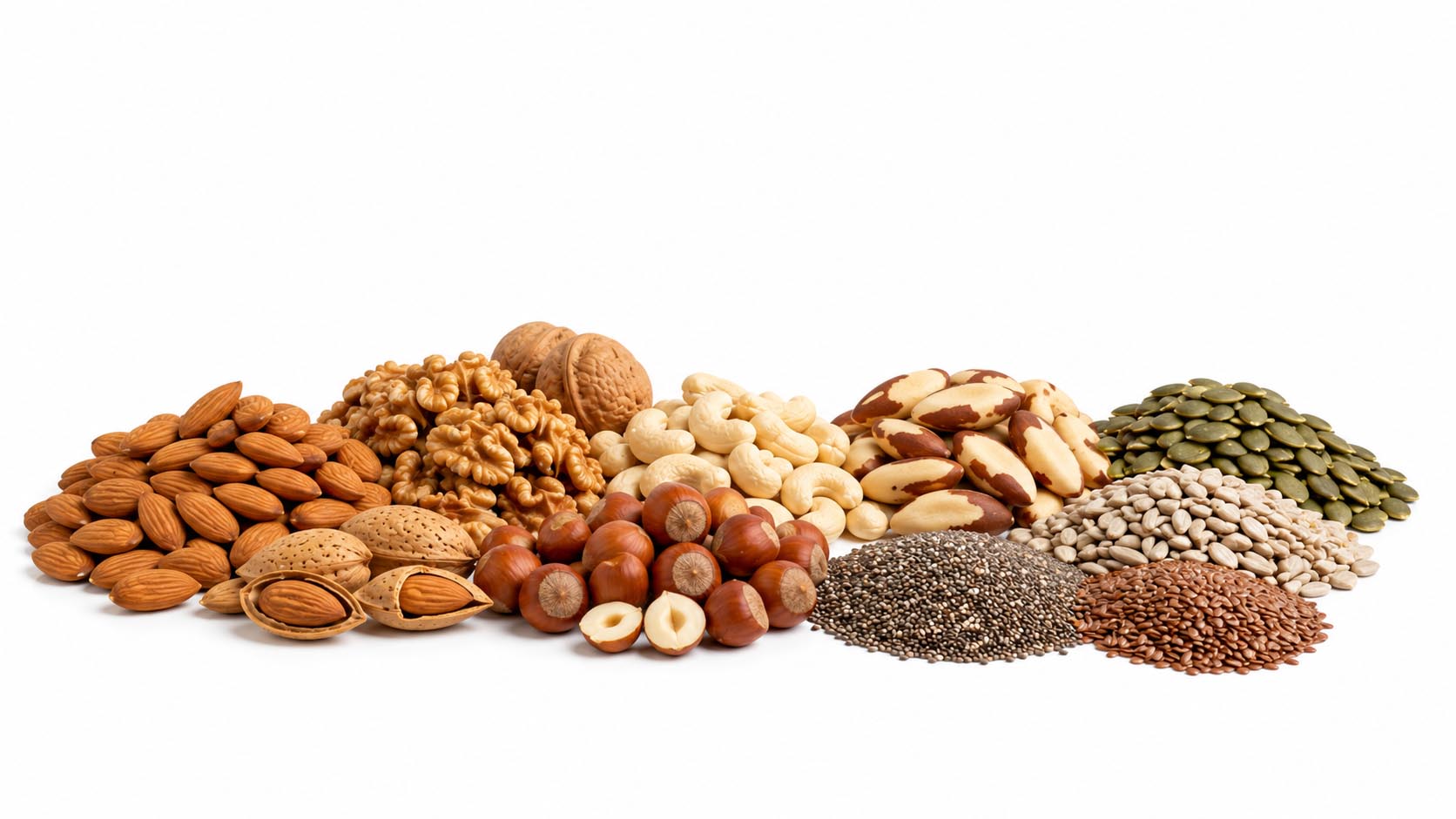
Nuts and seeds pack the most nutrition into the smallest serving of any plant food. They are calorie-dense by virtue of their oil content, with most varieties sitting between 500 and 700 kcal per 100 g, but the fat profile is dominated by mono-unsaturated and poly-unsaturated fats rather than saturated. Long-running observational studies (Nurses' Health Study, Adventist Health Study, PREDIMED in Spain) have linked regular nut consumption to better cardiovascular outcomes; the effect size is modest but consistent across populations.
Different nuts and seeds carry different nutritional emphases. Walnuts and flaxseed are rare plant sources of alpha-linolenic acid (ALA), the omega 3 precursor the body can convert into longer-chain forms (less efficiently than from oily fish, but still usefully). Almonds carry vitamin E, calcium and magnesium. Brazil nuts contain so much selenium that two or three a day cover the daily requirement. Cashews are higher in carbohydrate and lower in fat than most tree nuts. Sesame is uniquely high in calcium and forms the basis of tahini and halva. Chia and flax expand to a gel when soaked and supply useful soluble fibre.
Tree nuts (almond, walnut, cashew, hazelnut, pecan, pistachio, Brazil, macadamia, pine) and peanuts (technically a legume but classified with nuts for allergen and culinary purposes) are among the most common food allergens in the UK. The Food Standards Agency requires bold-marking on packaging where any of the 14 named allergens are present. Tree-nut allergy is generally lifelong; peanut-allergic children sometimes outgrow the reaction. Cross-contamination in production facilities is a real risk for severe allergies.
Seeds are sometimes overlooked but are nutritionally similar to nuts at a lower price point. Sunflower, pumpkin, sesame, hemp, chia and flax are all available in UK supermarkets and health-food shops, and many are produced domestically. They sprinkle easily onto porridge, salads, soups and yogurt, and they store well in sealed containers in a cool cupboard. Pre-ground flaxseed loses its omega 3 to oxidation faster than whole; buy whole and grind small batches for best results.
Tahini, almond butter, cashew butter and other ground or pressed nut and seed butters share the nutrition of the source nut and don't appear separately. The entries below cover individual nuts and seeds in raw form. Each page lists per 100 g energy, protein, fat, fibre and key minerals where the source data reports them.