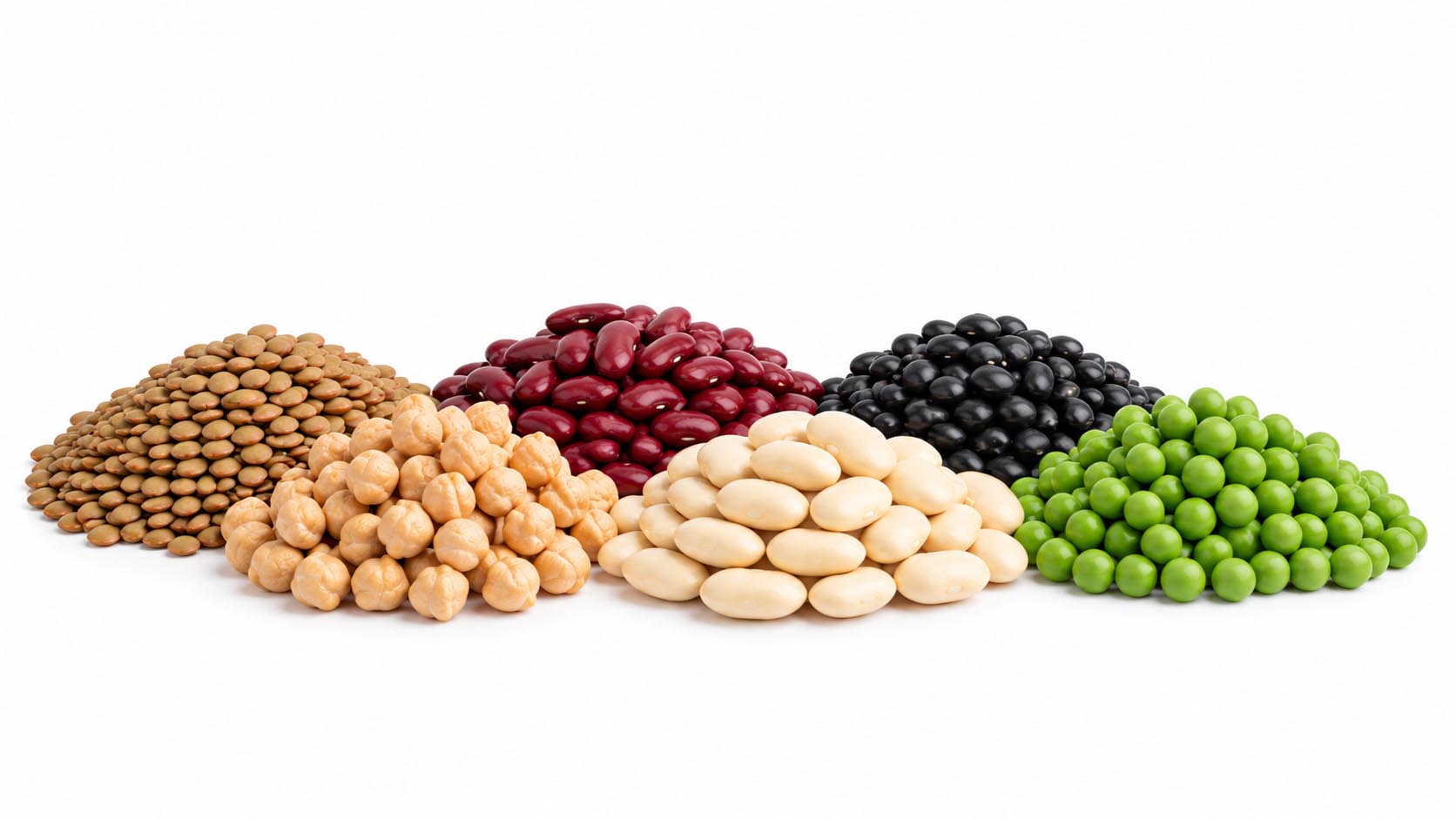
Pulses are the dry, edible seeds of legume plants. The category includes lentils (red, green, brown, Puy), chickpeas, the bean group (kidney, black, butter, cannellini, haricot, borlotti), soybeans and their derivatives such as tofu and tempeh, plus mung beans, black-eyed beans and split peas. Together they are among the cheapest sources of plant protein on any shop shelf and one of the most concentrated dietary sources of fibre, with useful amounts of folate, iron, magnesium and potassium.
The UK 5-a-day guidance counts a portion of pulses (around three heaped tablespoons of cooked beans, lentils or peas) as one of the daily five, although it caps the count at one regardless of how many pulse-based meals you eat in a day. The combination of slow-release carbohydrate, plant protein and fibre makes pulses unusually filling per calorie, and they slot easily into stews, curries, salads and soups without dominating the dish.
Plant proteins are sometimes described as "incomplete" because individual pulses are typically lower in one or two essential amino acids than animal proteins. The practical answer is to combine pulses with grains in the same meal (rice and beans, hummus on bread, dal with chapati): the amino-acid profiles complement each other and the resulting protein is functionally equivalent to a meat-based meal. Soybeans and quinoa are the exceptions among plant foods, providing all essential amino acids in adequate quantity on their own.
Cooking from dry takes more time but costs a fraction of tinned. Most pulses benefit from an overnight soak followed by a 30 to 60 minute simmer (lentils and split peas don't need the soak). Tinned pulses are pre-cooked and ready to drain, rinse and use; they preserve the same nutritional value with a small trade-off in salt content. Kidney beans must be boiled hard for at least 10 minutes when cooked from dry to neutralise lectins, a step that the canning process already covers.
Pulses are central to many traditional UK dishes (mushy peas, baked beans, pea and ham soup) and to most South Asian, Middle Eastern, Mediterranean and Latin American cuisines. The entries below cover individual pulses in raw form. Each page lists per 100 g energy, protein, carbohydrate and fibre.
Lima Beans (Fresh)Fresh lima beans provide 113 kcal and 6.8 g of protein per 100 g. Full nutrition facts and a complete guide to fresh and frozen lima beans (butter beans).
Sprouted LentilsSprouted lentils provide 106 kcal and 9 g of protein per 100 g — more bioavailable than dried. Full nutrition facts, health benefits, and a guide to sprouting lentils.
Fresh Fava Beans (Broad Beans, in Pod)Fresh fava beans (broad beans in pod) provide 88 kcal and 7.9 g of protein per 100 g. Full nutrition facts, history, and a complete guide to fresh broad beans.
Haricot Beans (Navy Beans, Sprouted)Sprouted navy beans (haricot) provide 67 kcal and 6.2 g of protein per 100 g. Full nutrition facts and a complete guide to haricot and navy beans.
Kidney Beans (Sprouted)Sprouted kidney beans provide 29 kcal and 4.2 g of protein per 100 g — a crisp, nutritious pulse sprout. Full nutrition facts and a complete guide to kidney beans.
Hyacinth Beans (Fresh, Immature)Fresh hyacinth beans (immature seeds) provide 46 kcal and 2.1 g of protein per 100 g. Full nutrition facts and a guide to fresh hyacinth beans in cooking.
Edamame (Green Soybeans)Edamame (green soybeans) provides 147 kcal and 12.9 g of protein per 100 g — one of the most protein-dense vegetables available. Full nutrition facts and cooking guide.
Soybeans (Sprouted)Sprouted soybeans provide 122 kcal and 13.1 g of protein per 100 g — highly nutritious and versatile. Full nutrition facts, health benefits, and a complete guide.
Snap Beans (Green and Yellow Beans)Snap beans (green and yellow beans) provide 31 kcal and 1.8 g of protein per 100 g — a low-calorie vegetable. Full nutrition facts, history, and a complete cooking guide.
Mung Bean SproutsMung bean sprouts provide 30 kcal and 3 g of protein per 100 g — the crisp sprouts used in Asian stir-fries and salads. Full nutrition facts, history, and cooking guide.
Pinto Beans (Sprouted)Sprouted pinto beans provide 62 kcal and 5.3 g of protein per 100 g. Full nutrition facts and a complete guide to pinto beans — a staple of Mexican and Tex-Mex cuisine.
Winged Beans (Fresh)Fresh winged beans provide 49 kcal and 7 g of protein per 100 g — exceptionally high protein for a fresh vegetable bean. Full nutrition facts and cooking guide.
Lentils (Green and Brown, Dried)Lentils provide 352 kcal and 24.6 g of protein per 100 g dried. Full nutrition facts, history, and a complete cooking guide for green and brown lentils.
Tofu (Firm)Firm tofu provides 144 kcal and 17.3 g of protein per 100 g — a complete plant protein. Full nutrition facts, history, health benefits, and a complete cooking guide.
Adzuki BeansAdzuki beans provide 329 kcal and 19.9 g of protein per 100 g dried — a sweet, earthy red bean central to East Asian cuisine. Full nutrition facts, history, and cooking guide.
Black BeansBlack beans provide 341 kcal and 21.6 g of protein per 100 g dried. Full nutrition facts, history, and cooking guide for this staple of Latin American and Caribbean cuisine.
French Beans (Flageolet, Dried)Dried French beans (flageolet) provide 343 kcal and 18.8 g of protein per 100 g, with 25.2 g of fibre. Full nutrition facts, history, and cooking guide.
Pink Beans (Dried)Pink beans provide 343 kcal and 21 g of protein per 100 g dried. Full nutrition facts and a guide to these mild, versatile beans used across Latin American cuisine.
Small White Beans (Dried)Small white beans provide 336 kcal and 21.1 g of protein per 100 g dried, with 24.9 g of fibre — one of the highest-fibre pulses available. Full nutrition facts.
Yellow Beans (Dried)Yellow beans provide 345 kcal and 22 g of protein per 100 g dried, with 25.1 g of fibre. Full nutrition facts and a guide to dried yellow beans.
Chickpeas (Garbanzo Beans)Chickpeas provide 378 kcal and 20.5 g of protein per 100 g dried. Full nutrition facts, history, and a complete cooking guide for the world's most important pulse.
Lima Beans / Butter Beans (Dried)Dried lima beans (butter beans) provide 338 kcal and 21.5 g of protein per 100 g, with 19 g of fibre. Full nutrition facts, history, and a complete cooking guide.
Baby Lima Beans (Dried)Baby lima beans provide 335 kcal and 20.6 g of protein per 100 g dried, with 20.6 g of fibre. Full nutrition facts and a guide to baby limas.
Urad Dal (Black Gram, Dried)Urad dal (black gram) provides 341 kcal and 25.2 g of protein per 100 g dried. Full nutrition facts, history, and a complete cooking guide for this South Asian staple.
Yard-Long Beans (Dried)Dried yard-long beans provide 347 kcal and 24.3 g of protein per 100 g. Full nutrition facts, history, and a cooking guide for this Southeast Asian staple.
Winged Beans (Dried)Dried winged beans provide 409 kcal and 29.7 g of protein per 100 g — one of the highest-protein pulses in the world. Full nutrition facts, history, and cooking guide.
Red Lentils (Split, Dried)Red lentils provide 358 kcal and 23.9 g of protein per 100 g dried. Full nutrition facts, history, and a complete cooking guide for split red lentils.
Black Turtle BeansBlack turtle beans provide 339 kcal and 21.3 g of protein per 100 g dried. Full nutrition facts and a guide to this classic Latin American staple bean.
Cranberry Beans (Borlotti)Cranberry beans (borlotti) provide 335 kcal and 23 g of protein per 100 g dried, with 24.7 g of fibre. Full nutrition facts, history, and cooking guide.
Great Northern BeansGreat Northern beans provide 339 kcal and 21.9 g of protein per 100 g dried, with 20.2 g of fibre. Full nutrition facts, history, and cooking guide.
White Beans (Cannellini, Dried)White beans (cannellini) provide 333 kcal and 23.4 g of protein per 100 g dried. Full nutrition facts, history, and a complete cooking guide for cannellini and white beans.
Broad Beans (Dried Fava Beans)Dried broad beans (fava beans) provide 341 kcal and 26.1 g of protein per 100 g, with 25 g of fibre. Full nutrition facts, history, and a complete cooking guide.
Hyacinth Beans (Lablab, Dried)Dried hyacinth beans (lablab) provide 344 kcal and 23.9 g of protein per 100 g, with 25.6 g of fibre. Full nutrition facts, history, and cooking guide.
NattoNatto: fermented whole soya beans, a traditional Japanese food. The headline UK micronutrient interest is vitamin K2 (menaquinone-7), the highest of any food.
Read this page online at www.nourishmentforlife.org/pulses